
Transform Your Life: How Consistency Helps You Become Stronger Every Day
Strength, fitness, and personal growth are not built overnight. Many people start with enthusiasm, only to lose momentum after a few weeks due to impatience, lack of direction, or unrealistic expectations. The truth is that lasting transformation—whether physical, mental, or emotional—comes from consistency. Daily habits, repeated effort, and gradual improvement compound over time to produce remarkable results. Consistency is the cornerstone of becoming stronger every day, not just in terms of muscle and endurance but also in mental resilience, discipline, and overall life success. By committing to a routine, maintaining focus, and embracing gradual progress, anyone can transform their life and achieve lasting strength.
The first principle of consistency is understanding the power of small, daily actions. Beginners often make the mistake of attempting extreme routines or expecting immediate results, leading to frustration and burnout. Instead, small actions performed consistently—like completing a few sets of squats, push-ups, or planks, taking daily walks, or practicing mindfulness—accumulate over time. These minor but consistent efforts strengthen muscles, build endurance, improve posture, and enhance mobility, while also fostering mental resilience and discipline. Consistency ensures that progress is sustainable and that habits become ingrained, creating a foundation for long-term transformation.
Structured workouts form the backbone of consistent strength development. Compound exercises like squats, lunges, push-ups, rows, and planks are highly effective for beginners because they engage multiple muscle groups simultaneously. Learning proper form and executing exercises regularly ensures that muscles are challenged without risking injury. Progressive overload—the gradual increase of weight, repetitions, or intensity—reinforces growth over time. When beginners focus on consistency rather than intensity, they create a routine that builds strength safely, efficiently, and steadily. This structured approach allows for measurable progress, making it easier to stay motivated and committed.
Consistency also applies to recovery and rest. Muscles grow and adapt during recovery, not just during exercise. Neglecting rest can lead to fatigue, burnout, or injury, which disrupts progress. Daily strength-building routines should incorporate active recovery, stretching, mobility work, and adequate sleep. By balancing training with recovery, beginners can maintain energy, prevent setbacks, and continue growing stronger over time. Consistent attention to recovery ensures that physical improvements are sustainable and that the body remains resilient under increasing demands.
Nutrition plays a critical role in supporting consistency. Without proper fuel, even the most dedicated routines can stall. Protein is essential for muscle repair, carbohydrates provide energy for workouts, and healthy fats support hormonal balance and recovery. Hydration is equally important, as it impacts energy, performance, and overall health. By consistently following balanced nutrition, individuals ensure their bodies are prepared for daily challenges and capable of responding effectively to exercise. Consistent dietary habits support strength gains, endurance, and mental clarity, enhancing overall performance.
Mental consistency is as important as physical consistency. Developing a growth-oriented mindset allows individuals to embrace challenges, learn from setbacks, and persist through difficult moments. Daily habits such as positive self-talk, visualization, mindfulness, and goal reflection reinforce mental resilience. By training the mind to stay focused and motivated, beginners can overcome obstacles that might otherwise derail progress. Mental consistency strengthens discipline, reduces procrastination, and fosters the confidence needed to maintain daily routines, ultimately amplifying physical and personal growth.
Tracking progress reinforces consistency by providing tangible evidence of improvement. Recording workouts, noting increased repetitions or weight, tracking measurements, or documenting milestones creates accountability and motivation. Seeing incremental improvements over days, weeks, and months reinforces the value of daily effort and helps maintain focus. Celebrating these small wins encourages continued commitment and makes the journey more enjoyable. Tracking also highlights areas that need improvement, allowing for adjustments in training, recovery, or nutrition to optimize growth.
Flexibility and mobility should also be practiced consistently to prevent injuries and maintain functional movement. Incorporating dynamic stretches before workouts, static stretches afterward, and mobility drills throughout the week ensures joints and muscles remain healthy and adaptable. Flexibility supports proper form in strength exercises, enhances performance, and reduces the risk of overuse injuries. Consistent attention to mobility allows the body to handle progressive strength training without setbacks, supporting sustainable growth over time.
Building consistency requires planning and structure. Setting aside dedicated time for workouts, meals, recovery, and mindfulness ensures that habits are repeated reliably. Breaking routines into manageable blocks—such as 20–45 minutes of exercise daily, short stretching sessions, or mindful breathing—makes adherence easier and reduces overwhelm. Consistent scheduling prevents skipped workouts, missed meals, or neglected recovery, creating a balanced lifestyle that supports strength gains. Over time, these habits become automatic, reinforcing long-term discipline and commitment.
Accountability and support systems enhance consistency. Surrounding yourself with like-minded individuals, mentors, or fitness communities encourages adherence and motivation. Sharing goals, progress, and challenges with others reinforces commitment and provides encouragement during difficult periods. Social support helps maintain consistency, as it creates a network of accountability and inspiration. Regular check-ins, challenges, or group sessions can further strengthen habits and make the process more engaging.
Consistency compounds over time. Just as small daily actions produce measurable physical gains, consistent mental and emotional practices enhance focus, resilience, and confidence. Strength gained through repeated effort extends beyond the gym into everyday life, improving productivity, decision-making, and stress management. Individuals who commit to daily progress experience transformative effects on their health, relationships, and overall quality of life. By embracing consistency, you lay the foundation for sustainable growth that lasts far beyond temporary gains or short-term motivation.
Finally, embracing patience and long-term thinking is essential when cultivating consistency. Strength and personal transformation are not achieved overnight; they result from cumulative effort, persistence, and smart habits. Beginners must recognize that setbacks, plateaus, or slow progress are part of the process and not reasons to quit. Consistent daily actions, no matter how small, create a compounding effect that leads to lasting results. By focusing on effort rather than immediate outcomes, individuals can maintain motivation, develop discipline, and achieve strength in every area of life.
In conclusion, consistency is the key to becoming stronger every day and transforming your life. Small, repeated actions in workouts, nutrition, recovery, mindset, and mobility compound to produce significant physical, mental, and emotional growth. Structured routines, progressive overload, proper recovery, balanced nutrition, mental resilience, tracking progress, and accountability are all tools that support daily consistency. By committing to consistent effort, embracing patience, and maintaining focus, anyone can build strength, confidence, and lasting transformation. Every day is an opportunity to grow stronger, and with consistent effort, the journey from where you are today to the best version of yourself becomes achievable, sustainable, and truly transformative.
The process of achieving success requires multiple steps which people must take every day until they reach their objectives. The process results from multiple small actions which people execute at regular intervals throughout their life. People think that achieving significant goals demands extensive work but actual permanent change occurs through the implementation of basic habits which people execute every day. Your success depends on your ability to maintain consistent progress toward your established objectives. The daily practice of developing yourself through small improvements leads to your accomplishment of becoming a more powerful version of yourself.
People who consistently pursue their goals will experience maximum benefits because it leads to their personal development. The practice of reading ten pages from a book every day leads to reading ten pages of a book which results in knowledge acquisition for the reader. The complete process of reading books leads to the reader obtaining knowledge about various subjects. The same approach works for physical training and skill acquisition and mental development. The practice of making small improvements every day results in major achievements which emerge over an extended time period. The process of making small efforts leads to extraordinary results through a system which creates compounded growth similar to savings account interest.
Discipline develops through the practice of consistency. People experience two different states of motivation because they feel energetic on some days while they experience exhaustion and discouragement on other days. The use of motivation as your only driving force makes it easy for you to abandon your tasks. People who develop discipline continue working when they experience lack of motivation. Your capacity to remain dedicated to your work during challenging circumstances helps you develop stronger character and mental resilience. Your resilience develops through time because you will become ready to face all future obstacles.
The ability to maintain consistency through your work brings another major benefit which enables you to develop self-assurance. Your ability to keep your word to yourself confirms your reliability and your ability to do things. Your self-assurance develops through this process. The sight of progress, even its smallest form, inspires you to pursue greater achievements. People need to put forth ongoing effort because it helps them build self-assurance instead of achieving their goals through perfect execution.
Discipline develops through the practice of regular action which brings results to my life. The presence of consistency leads to better results for my work. The practice of consistent work leads to achievement because it requires regular effort which brings results. The process of building sustainable habitats requires continuous work which brings results for my objectives. The practice of consistent effort leads to permanent results which emerge as time passes. The process of making small efforts leads to extraordinary results through a system which creates compounded growth similar to savings account interest. The process of building sustainable habitats requires continuous work which brings results for my objectives.
The process of change requires multiple small alterations instead of one major transformation. The process requires people to take important decisions throughout their daily activities. Your character develops through your daily habits which you establish through consistent practice. The journey demands you to maintain patience while you stay dedicated and believe in the process. Your daily dedication will lead to your growth in strength and knowledge and success.
The main advantage of maintaining consistency in life brings people the power to develop mental strength. Your resilience develops when you choose to keep working through your fatigue and lack of motivation during tough times. Your brain develops the ability to face various challenges with bravery when you endure your unease. Daily practice of this discipline will build your emotional strength and mental concentration. You start to understand that success comes from your regular actions not from your current emotional state.

People who practice their tasks with regularity will form beneficial practices. Your established habits will determine your daily activities which will influence your future outcomes. Healthy routines and productive work habits and positive thinking will become automatic for you after you practice them consistently. Success becomes effortless for people when they develop good behaviors into their daily routines.
People who demonstrate consistency in their actions will grow their self-respect. People build self-trust through commitment fulfillment, which leads them to make more promises. Your self-trust will lead to increased self-confidence, which will help you establish larger objectives. You begin to believe that you possess the ability to develop and succeed.
Strength Starts Here: Essential Workouts Every Beginner Should Learn
Every fitness journey begins with a single step, and for beginners, building strength lays the foundation for long-term progress. Strength is not just about appearance; it is essential for functional movement, injury prevention, improved metabolism, and overall health. The right approach ensures that beginners develop strength safely, effectively, and sustainably. This requires learning fundamental exercises that target major muscle groups, improve coordination, and prepare the body for more advanced training. By focusing on essential workouts from the start, beginners can build confidence, create proper movement patterns, and establish habits that promote consistent improvement over time.
One of the first essential workouts for beginners is the squat. Squats are a compound movement that engages the quadriceps, hamstrings, glutes, and core. They mimic everyday activities like sitting, standing, and lifting, making them highly functional. Beginners can start with bodyweight squats to learn proper form: keeping the chest up, hips back, and knees aligned with the toes. Once mastered, squats can be progressed with resistance bands, dumbbells, or a barbell. Properly executed squats not only build lower body strength but also enhance balance, stability, and flexibility, forming the cornerstone of a beginner’s strength routine.
Push-ups are another foundational exercise every beginner should learn. Push-ups target the chest, shoulders, triceps, and core while also engaging stabilizing muscles. They can be modified for beginners by performing them on the knees, using an elevated surface, or incorporating partial ranges of motion. Learning push-ups develops upper body strength, improves posture, and strengthens the core, all of which are essential for functional fitness. With consistent practice, beginners can gradually progress to full push-ups, increase repetitions, and even explore variations such as incline or decline push-ups to challenge the muscles differently.
Lunges are essential for unilateral strength, meaning they train each leg independently. This helps correct muscle imbalances, improve coordination, and enhance stability. Lunges engage the quadriceps, glutes, hamstrings, and core, while also promoting balance and proprioception. Beginners can start with stationary lunges before progressing to walking lunges, reverse lunges, or weighted variations. Proper form involves keeping the torso upright, ensuring the front knee does not extend past the toes, and engaging the core for stability. Lunges are a versatile exercise that complements squats and provides a well-rounded lower-body strength foundation.
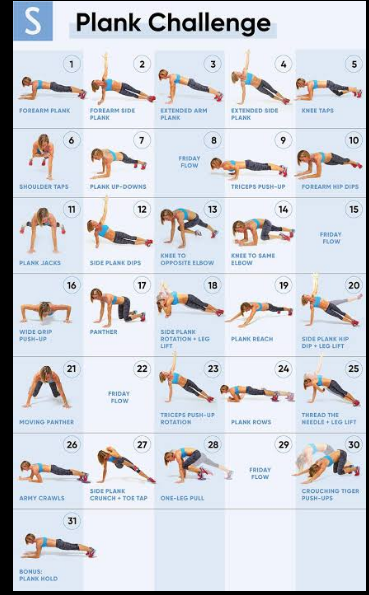
Planks are a core exercise that every beginner should incorporate into their routine. A strong core supports nearly all movements, improves posture, and reduces the risk of injury. Planks engage the deep abdominal muscles, lower back, and shoulders, providing a stable foundation for strength exercises. Beginners can start with short holds, focusing on maintaining a straight line from head to heels and avoiding sagging or arching of the back. Over time, planks can be progressed with side planks, plank reaches, or weighted variations to increase intensity and continue challenging the core.
Rows are essential for developing back strength and counteracting the forward posture often caused by prolonged sitting or computer use. Rows target the upper and middle back, biceps, and rear shoulders, promoting a balanced physique and improving posture. Beginners can start with resistance bands, dumbbells, or a cable machine, focusing on controlled movements and squeezing the shoulder blades together. Strong back muscles support overall strength development, enhance performance in compound lifts, and reduce the risk of injuries, making rows a critical component of a beginner’s routine.
Glute bridges are an effective exercise for activating and strengthening the glutes, hamstrings, and lower back. Strong glutes improve posture, hip stability, and overall lower body power, while also preventing injuries in the lower back and knees. Beginners can start with bodyweight bridges, ensuring they lift the hips fully while engaging the core and glutes. Glute bridges can be progressed by adding resistance bands, dumbbells, or single-leg variations, making them a versatile addition to any strength program.
Deadlifts, when taught correctly, are another essential exercise for beginners. Deadlifts engage the posterior chain, including the hamstrings, glutes, lower back, and traps. They teach proper hip hinge mechanics, which are critical for safe lifting in daily life and advanced training. Beginners should start with light weights or even a broomstick to master form, focusing on keeping the spine neutral, hinging at the hips, and engaging the core. Gradually increasing weight and repetitions allows for significant strength gains and improved functional fitness.
Overhead presses are crucial for building shoulder strength and stability. This exercise targets the deltoids, triceps, and upper back while engaging the core to maintain balance. Beginners can start with light dumbbells, resistance bands, or even just a barbell with no weight to practice technique. Proper form involves pressing straight overhead without arching the lower back, keeping the core tight, and moving through a full range of motion. Overhead presses complement push-ups and rows, contributing to balanced upper-body strength development.
Pull-ups or assisted pull-ups are essential for developing upper back and arm strength. While full pull-ups may be challenging for beginners, assisted versions with resistance bands, machines, or negative reps allow gradual progression. Pull-ups engage the lats, biceps, traps, and forearms while improving grip strength and posture. Regular practice, combined with complementary exercises like rows and push-ups, helps beginners build a strong, balanced upper body.
Mobility and flexibility exercises should also be integrated into a beginner’s routine. Dynamic stretches before workouts prepare the joints and muscles for movement, while static stretches after training aid recovery and improve range of motion. Flexibility work enhances performance, prevents injuries, and supports long-term strength development. Incorporating yoga, foam rolling, or targeted mobility drills ensures that the body remains resilient and adaptable as strength increases.
Consistency, progression, and recovery are the pillars of effective strength development. Beginners should start with manageable routines, focusing on form and frequency rather than intensity. Gradually increasing resistance, repetitions, or sets over time ensures continued progress without causing injury or burnout. Adequate recovery, including rest days, sleep, and nutrition, supports muscle repair and growth, making strength gains sustainable. Tracking progress, setting achievable goals, and celebrating small victories further reinforce motivation and adherence.
In conclusion, building strength as a beginner starts with learning essential workouts that target major muscle groups, improve functional fitness, and establish proper movement patterns. Squats, push-ups, lunges, planks, rows, glute bridges, deadlifts, overhead presses, pull-ups, and mobility exercises form the foundation for a safe and effective routine. By focusing on consistency, progressive overload, proper form, and recovery, beginners can develop a balanced, strong, and resilient body. Strength starts here, with these fundamental exercises, creating a lifelong habit of fitness, confidence, and capability.
Starting your fitness journey can feel overwhelming, but building strength does not require complicated equipment or advanced techniques. The key is to focus on simple, foundational exercises that train your entire body. The essential workouts teach beginners to create proper body movement patterns while they learn to maintain body stability and build a strong foundation for their upcoming development.

The squat stands as the most crucial exercise that beginners must learn. Squats build strength in your legs and glutes and core muscles while they enhance your overall body balance. The exercise functions as an essential movement because it simulates the common activities of sitting and standing. You should start with bodyweight squats until you reach the point of needing to use additional weight.
Push-ups represent another effective exercise that beginners can perform. The exercise works your chest and shoulders and arms while engaging your core muscles. If standard push-ups feel difficult, start with knee push-ups or wall push-ups. You should raise the intensity level of your work as your body strength reaches new heights.
Planks provide a strong method to develop core strength. The core muscles create support for your spine which helps you maintain better posture and decreases your chances of getting injured. You should start by holding a plank position for 20 to 30 seconds which you will extend as your strength develops.
Lunges form a necessary component of fitness training. The exercise helps develop leg strength which enhances your balance abilities while it corrects muscle strength differences between both body sides. You should start with bodyweight lunges like squats to practice proper body movement.
Basic pulling exercises which include resistance band rows and assisted pull-ups should be used as your fundamental exercise. These movements strengthen your back and improve posture, especially important if you spend long hours sitting.

You should prioritize regular exercise over high-intensity workouts when you are just starting out. You should spend three to four days per week to learn about correct body movements while your body needs time to heal from workouts. The foundational exercises will yield results after you demonstrate patience and dedication.